In an era dominated by rising ad costs, privacy regulations, and algorithm volatility, many eCommerce operators are rediscovering a powerful, often underestimated channel: email marketing.
For Shopify store owners targeting US and European markets, email is no longer just a retention tool—it’s becoming a primary revenue driver. While paid acquisition channels like Meta Ads and TikTok continue to fluctuate, email marketing offers something increasingly rare: stability, control, and high ROI.
According to recent industry benchmarks, email marketing consistently delivers one of the highest returns among digital channels, often exceeding $30–$40 for every $1 spent. But this performance is not automatic. It depends heavily on how well your email flows are structured, personalized, and optimized.
This article explores why email marketing is making a comeback and outlines the high-converting flows every Shopify store should implement to maximize revenue.
Why Email Marketing Is Resurging in 2026
Rising Customer Acquisition Costs (CAC)
Over the past few years, paid traffic has become significantly more expensive. CPMs on major ad platforms have increased, and conversion rates have declined due to audience fatigue and privacy limitations.
This has forced brands to shift focus from pure acquisition to lifecycle marketing, where email plays a central role.
First-Party Data Is King
With the decline of third-party cookies and stricter data privacy regulations such as GDPR and CCPA, owning your customer data is critical. Email gives you direct access to your audience without relying on external platforms.
Owned Channel Equals Predictable Revenue
Unlike social media algorithms, email lists are assets you fully control. This predictability is especially valuable for scaling Shopify stores.
The Foundation: Email Flows vs Campaigns
Before diving into specific flows, it’s important to understand the difference between campaigns and automations.
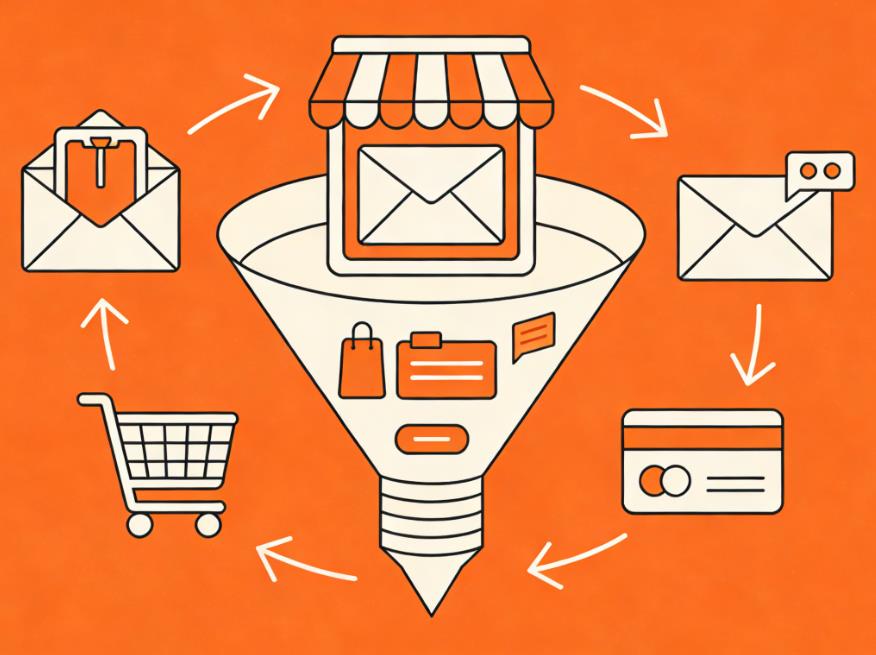
Campaigns are one-time broadcasts, such as promotions or product launches. Flows, on the other hand, are automated sequences triggered by user behavior.
While campaigns generate short-term revenue spikes, flows create consistent, ongoing income. In many successful Shopify stores, flows account for 30% to 50% of total email revenue.
Core High-Converting Email Flows for Shopify Stores
Welcome Flow (The Most Underrated Revenue Driver)
The welcome flow is often the first impression a customer has after subscribing. When executed correctly, it can convert 10% to 20% of new subscribers into paying customers.
The first email should be sent immediately, delivering any promised discount and clearly communicating your value proposition with a strong call to action.
The second email should focus on your brand story, helping build emotional connection and trust.
The third email can highlight customer reviews, testimonials, or user-generated content to reinforce credibility.
The fourth email should showcase best-selling products, guiding users toward proven choices.
The final email in the sequence should introduce urgency, such as a limited-time offer or expiring discount.
Segmenting users based on behavior, such as whether they browsed products, can significantly improve performance.
Abandoned Cart Flow (High Intent, High ROI)
This flow targets users who have added products to their cart but did not complete checkout, making it one of the highest-converting automations.
The first email should be sent within one to two hours, simply reminding users to complete their purchase with a clear call to action.
The second email should follow within 12 to 24 hours and address common objections such as shipping costs, return policies, or product quality.
The third email should introduce urgency or an incentive, such as a discount or free shipping, within 24 to 48 hours.
Including dynamic product images and direct checkout links can significantly increase recovery rates.
Browse Abandonment Flow
Many users browse products without adding anything to their cart. This flow targets those mid-intent visitors.
The first email should be sent within four to six hours, reminding users of the products they viewed.
The second email can recommend similar or complementary items.
The third email should reinforce trust through reviews or social proof.
Post-Purchase Flow (Retention and LTV Engine)
Post-purchase emails are often underutilized, yet they are critical for increasing customer lifetime value.
The first message should enhance the order confirmation experience by thanking the customer and setting expectations.
A follow-up email within three to five days can provide product usage tips or tutorials.
Another email within seven to ten days should introduce cross-sell opportunities.
A review request can be sent after 14 to 21 days.
Finally, replenishment reminders should be timed based on the product lifecycle.
Winback Flow (Reactivating Dormant Customers)
This flow targets customers who have not engaged or purchased within 60 to 120 days.
The first email should re-establish connection with a friendly “we miss you” message.
The second email can include an incentive to return.
The final email should create urgency with a last-chance offer.
VIP and Loyalty Flow
High-value customers should be treated differently.
By segmenting your top 10% to 20% customers based on lifetime value, you can create exclusive experiences such as early access to product launches, special discounts, and personalized recommendations.
Advanced Strategies to Boost Conversion Rates
Personalization Beyond First Name
Modern email marketing goes far beyond basic personalization.
Brands should leverage purchase history, browsing behavior, geographic data, and predictive insights to deliver highly relevant content.
Dynamic content blocks are especially effective in increasing engagement.
Behavioral Segmentation
Segmenting your audience into meaningful groups such as new subscribers, repeat buyers, high spenders, and inactive users allows for more targeted messaging.
Each segment should receive tailored communication aligned with their behavior and lifecycle stage.
Timing and Frequency Optimization
Sending too many emails can lead to fatigue, while too few can result in missed revenue opportunities.
A balanced approach typically includes one to two campaigns per week, with carefully spaced automation flows that avoid overlap.
Mobile Optimization
With more than 60% of emails opened on mobile devices, optimization is essential.
Emails should use responsive design, concise copy, clear calls to action, and fast-loading visuals.
A/B Testing
Continuous testing is key to long-term success.
Marketers should experiment with subject lines, send times, call-to-action placement, and the use of incentives.
Even small improvements can compound into significant gains over time.
Key Metrics Shopify Store Owners Should Track
To effectively measure performance, focus on metrics such as open rate, click-through rate, conversion rate, revenue per recipient, list growth rate, and unsubscribe rate.
Among these, revenue per recipient is often the most meaningful indicator of overall email performance in eCommerce.
Common Mistakes to Avoid
Relying too heavily on discounts can erode profit margins and train customers to wait for promotions instead of purchasing at full price.
Poor list hygiene can negatively impact deliverability, so it is important to regularly remove inactive subscribers.
Ignoring deliverability issues can cause emails to land in spam folders. Proper domain authentication and maintaining a strong sender reputation are essential.
Weak copywriting is another common issue. Effective emails should clearly address customer pain points, emphasize benefits, create urgency, and include strong calls to action.
Recommended Tech Stack for Shopify Email Marketing
Successful Shopify stores typically rely on specialized email platforms.
Klaviyo is known for its advanced segmentation and automation capabilities.
Omnisend is a strong option for omnichannel marketing strategies.
Postmark and Mailgun are commonly used for transactional emails.
Shopify Email offers a simple, native solution for beginners.
The Future of Email Marketing in eCommerce
Looking ahead, email marketing will continue to evolve.
AI-driven personalization will enable brands to predict customer behavior, optimize send times, and dynamically generate content.
Integration with SMS will become more common, creating multi-channel customer journeys.
Zero-party data collection through interactive content such as quizzes and surveys will help brands better understand their audience.
Email marketing is not just making a comeback. It is becoming one of the most reliable and scalable revenue channels for Shopify stores.
In competitive Western markets, success depends on execution. The difference between average and high-performing brands lies in strategic flow design, deep personalization, and continuous optimization.
When implemented correctly, email marketing can evolve from a supporting channel into a core growth engine that delivers consistent revenue regardless of changes in advertising platforms.
In a landscape where attention is increasingly expensive and unpredictable, email remains one of the few channels where brands truly own the relationship with their customers. That makes it an essential capability for any serious eCommerce business.

Leave a Reply