
Peak import season is here, with global trade policies and changing consumer habits pushing imports to record highs.
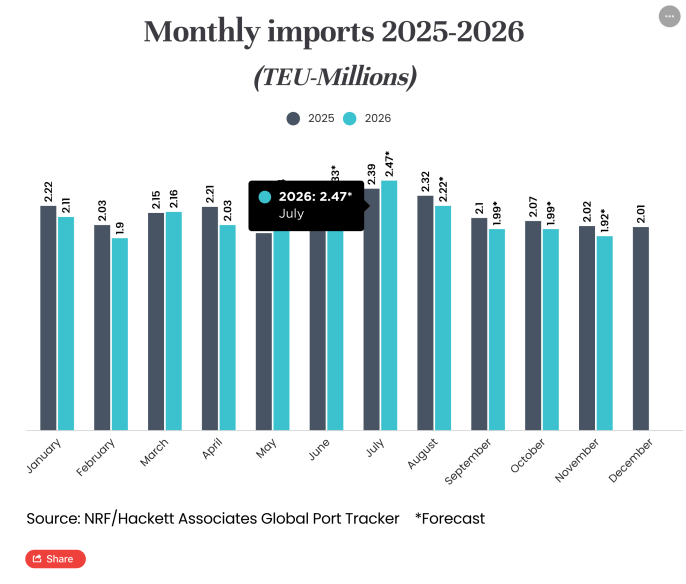
New data from the Global Port Tracker, published by the National Retail Federation and Hackett Associates, shows that in July there will be an estimated all-time high of 2.47 million 20-foot-equivalent units (the container metric known as TEUs) docking at U.S. ports. Data from May shows that 2.24 million TEUs came through, an increase of 14.9% from May 2025 when Liberation Day tariffs slowed activity.
Jonathan Gold, NRF’s vice president of supply chain and customs policy, said July and August are typically the busiest months of the year for imports as companies get ready for the holidays. That has picked up in recent years as shoppers pull their holiday shopping forward.
But this year has added uncertainties that are making companies want to get goods faster. Beyond the war in Iran and fuel price instability, brands may face new tariffs of 10-12.5% on imports from 60 different countries that could take effect in August. Many brands are shipping earlier in the summer to avoid having their cargo in the water when the new tariffs hit, Gold said.
“Retailers are trying to get their products here for the back-to-school season as well as the winter holidays, before those higher tariffs potentially take effect,” he said. “A lot of these companies have made their purchasing decisions six, nine, even 12 months ago. To then get hit with a tariff on top of that is a challenge, so that’s partly why they’re looking to pull ahead.”
For brands, busier ports mean that it’s even more critical to stay in close communication with supply chain partners, Gold said. More activity at the ports can open the door for more strain or complications in a company’s supply chain, while pulling shipments forward requires ensuring there’s enough drayage and warehouse capacity among supply chain partners.
“One of the big lessons retailers have learned over the years is making sure all of your partners in your supply chain are aware of what your plan is,” he said. “That way you can plan accordingly when things are getting pulled forward by making sure you’ve got the capacity, making sure you’ve got the warehouse space and making sure you’ve got the drayage capacity.”
The changing circumstances of where and when to import goods is unlikely to change anytime soon. Looking ahead, there are more potential tariffs that could hit:
- Exports from Brazil are facing a proposed 25% tariff that could be finalized by July 15 after a series of public hearings.
- The U.S. Trade Representative has an ongoing Section 301 investigation, which it started in March, related to “excess capacity and production” in 16 countries, including China, Vietnam and Korea, as well as the European Union.
- Another investigation started in June looks specifically at intellectual property concerns around exports from Vietnam.
Gold said that making shipping plans amid unknown tariff structures is becoming “the new normal” for brands.
“This is the age of disruption,” he said. “And so, making sure that you are prepared to deal with whatever’s happening next, having those plans in place and making sure your entire network understands what your plan is, is critically important.”
The week in tariffs
- Another progress report from U.S. Customs and Border Protection with updates on the tariff refund process will be filed in the U.S. Court of International Trade today, according to court records. So far, updates have shown progress since the system debuted in late April with some hiccups.
- A prior update filed on July 1 from Brandon Lord, the executive director of trade programs at CPB, said more than $104 billion in both potential and certified refunds had been accepted for processing. Approximately $71.06 billion of that had been sent to the U.S. Department of Treasury to be paid out.
- Companies like BJ’s Wholesale and Nike have said they’re expecting refunds. But based on calculations from the Cato Institute, there’s still a ways to go: The government still owes importers more than half of what is owed, at about $100.65 billion.

Leave a Reply